Libby—Bunny Junior relationship
The Death of Bunny MunroLibby and Bunny Junior’s relationship persists beyond Libby’s death as a bond carried in touch, memory, and visions. Its defining tension is that the boy remains deeply attached to his mother even as the details of her face begin to disappear. His recollections and imagined encounters make her absence neither simple forgetting nor uncomplicated consolation: she remains a source of tenderness, grief, and guidance, while the boy must learn to continue without her.
Early Bond and Maternal Tenderness
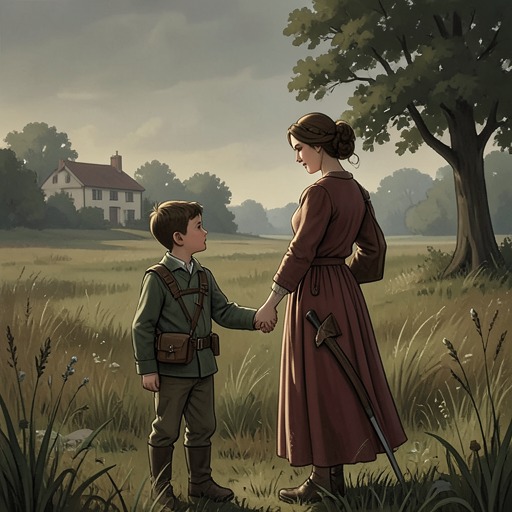
At Bunny Junior’s birth, Libby’s affection is immediate and physical. As she holds the baby, she places her raw, swollen fingers against his head, and he closes his eyes. Bunny Munro answers the newborn with jokes about his appearance, but Libby laughs and tells the baby not to listen because his father is jealous. The scene establishes a contrast between Bunny Munro’s awkward, mocking manner and Libby’s intimate care. The baby’s response to her touch makes their connection visible before he can speak.
That early gesture becomes significant in retrospect. Bunny Junior’s later sense of his mother is repeatedly organized around the feel of her hand: Libby holding him, stroking his forehead, and offering comfort through contact. A future recollection of her coming into his room to hold him and cry over him preserves both her tenderness and her pain. The remembered hand is not just a detail of childhood; it is the most immediate form in which her love remains available to him.
Memory and the Fear of Losing Her
Bunny Junior has an exceptional memory for facts, which he files in elaborate mental categories, yet that ability cannot protect his memories of Libby. He can recall the year construction began on the Eiffel Tower but finds it increasingly difficult to picture his mother. The contrast makes his loss especially stark: information remains orderly and retrievable, while the face he most wants to preserve dissolves.
He tries to hold their shared past still by arranging it as if it were an exhibition in the Booth Museum, where stuffed birds stand behind glass. In one remembered scene, Libby pushes him on a swing at St Ann’s Well Gardens. He can see himself high in the air, laughing, but cannot clearly see who is pushing. His mother has become a ghost-like, incomplete figure in the scene. The memory leaves him feeling suspended above the ground, motherless and beyond reach; he cries before turning his attention to another fear. The image gives form to the relationship’s central wound: the event survives, but the person who made it loving is fading from view.
Even so, the memories are not wholly lost. Looking back toward the sea and fields along the coastal road, Bunny Junior recalls Libby holding him and stroking his forehead. He remembers her hand as the softest, sweetest, warmest touch he has known, and imagines starlings tracing the angles of her face in the sky. The image joins a specific bodily memory to a fleeting pattern in the landscape. His wish is not for an explanation of death but to feel that reassuring hand again.
Visions and Continued Contact
Libby also returns to Bunny Junior in moments that blur memory, dream, and apparent visitation. While he waits in the Punto on Meeching Road in Newhaven, he thinks about quasars and their extraordinary brightness. He believes that if he stays there his mother will eventually find him. A shift in the air and the smell of her hand cream accompany the feeling of a hand on his brow, tracing his face and pressing a finger to his lips like an approximate kiss. A voice, which he cannot tell is his or hers, describes him as the most luminous object in the universe. The encounter transforms an encyclopedia fact into a language of attachment: the boy’s knowledge supplies an image for the love he hopes still reaches him.
Another appearance comes through mist. Bunny Junior sees Libby seated on a low cream brick wall opposite the Punto, wearing her Orange dressing gown and beckoning him closer. He steps out into the fog and sits beside her, immediately feeling warmth. In this vision, the bond can be spoken aloud: he apologizes, says how much he misses her, and rests his head against her body. Libby responds with an apology of her own and acknowledges that she was not strong enough. The exchange gives shape to the child’s grief without making the vision’s status certain; the scene presents the encounter through Bunny Junior’s experience rather than resolving whether Libby is literally present.
The conversation also turns from consolation to responsibility. When Bunny Junior asks what they will do about Bunny Munro, Libby tells him that his father cannot help him and is truly lost. The boy answers that he is the navigator. Libby affirms his strength and good heart, then tells him to persevere no matter what happens. Her care remains tender, but it does not promise that she can return or rescue him. Instead, the vision leaves him with an instruction to keep going.
The Bond’s Meaning After Loss
Bunny Junior’s connection to Libby is sustained by small, concrete traces: the remembered pressure of her hand, the smell of her hand cream, the Orange dressing gown, and the scenes he tries to keep intact in his mind. These details recur in different forms, from a fading recollection of the playground swing to an apparition in mist. The recurrence suggests a continuing relationship, but it does not cancel bereavement. Indeed, the boy’s visions arise alongside his fear that her face is disappearing, making comfort and loss inseparable.
The novel distinguishes this gentle, consoling bond from Bunny Munro’s own experience of Libby’s presence. At the public gathering, Bunny Munro sees his wife and asks her forgiveness; when he speaks of being haunted, Libby denies that she ever haunted him. That scene belongs to the father’s reckoning, not to Bunny Junior’s visions, and the contrast matters: the boy’s encounters center on touch, reassurance, and the strength to endure, while his father’s are entangled with guilt and the plea for pardon. Through Bunny Junior, Libby remains not merely the object of grief but an inward source of love and direction—one whose image may fade, even as the warmth associated with her continues to guide him.